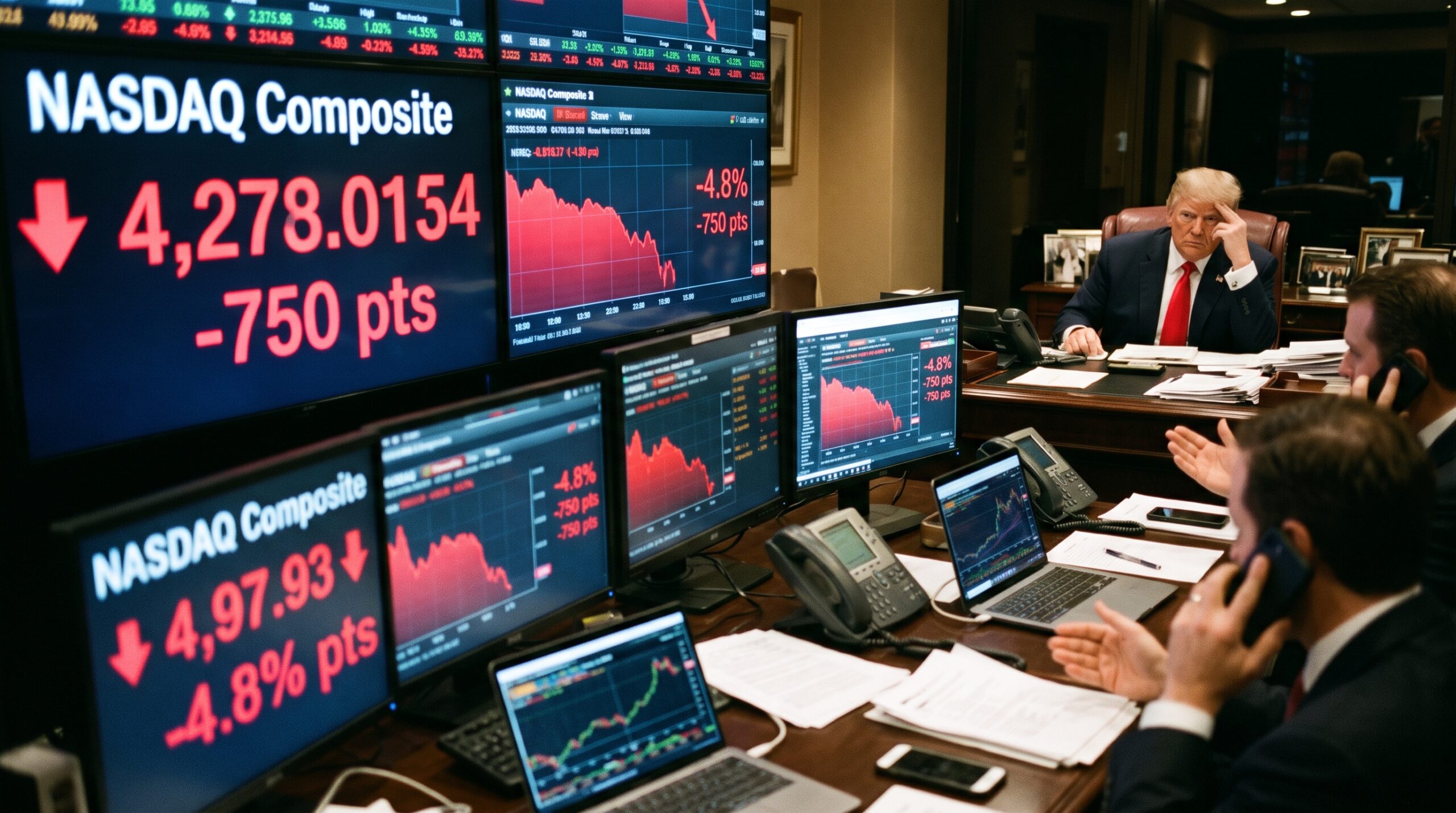
Nasdaq Selloff fears gripped futures markets overnight as early U.S. midterm election results pointed to a Democratic-led Congress, reviving investor anxiety over tighter regulation of the AI boom that has powered this year’s tech rally. Nasdaq-100 futures swung sharply lower in thin, volatile overnight trading on November 3 into November 4 — but the story got more interesting once AMD and Arista Networks reported earnings.
What makes this Nasdaq Selloff unusual isn’t just the political trigger — it’s the split-screen reaction happening at the same time. While index futures wobbled on regulatory uncertainty, two of the market’s biggest AI-infrastructure names posted blowout numbers that moved in the opposite direction entirely.
Nasdaq-100 futures fell as much as 2% overnight after midterm results pointed to a Democratic Congress, on fears of stricter AI regulation. Hours later, AMD (data-center revenue nearly doubled to $8.5B) and Arista Networks (+13% after hours) posted standout earnings that pulled the index off its lows — showing the dip was political, not a verdict on AI demand itself.
Why Did the Nasdaq Selloff Happen After the Midterms?
The Nasdaq Selloff wasn’t a blanket “markets dislike Democrats” reaction — reporting points to something more specific. Traders were pricing in the possibility that a Democratic-controlled Congress brings closer scrutiny of the AI sector, from data-centre energy use to the market concentration of a handful of mega-cap tech names. That’s a narrower, sector-specific worry than a broad economic one, which is part of why the reaction split so clearly by stock once individual earnings started landing.
Nasdaq Selloff: Confirmed Facts vs Unverified Claims
Overnight, election-driven moves like this attract a wide range of cited numbers depending on the exact snapshot and outlet. Here’s what we can stand behind versus what’s still murky.
AMD and Arista: The Different Story Inside the Nasdaq Selloff
This is the part of the Nasdaq Selloff story that matters most for anyone trying to read the bigger picture. If AI demand itself were weakening, you’d expect AI-infrastructure suppliers to fall alongside the index. Instead, AMD’s data-centre business nearly doubled in a year, and both Arista and Supermicro rallied double digits after hours. That split suggests the overnight dip was about political and regulatory uncertainty specifically — not a reassessment of whether companies actually need AI chips and networking gear.
Nasdaq-100 Futures
Down as much as 2% overnight on Nov 3 into Nov 4.
AMD Data-Centre Revenue
Nearly doubled year-over-year to $8.5 billion.
Arista Networks
+13% after hours on AI-infrastructure demand.
Primary Driver
Fear of tighter AI-sector regulation under a new Congress.
Reading an overnight futures move as a verdict on AI demand itself. The confirmed data points the other way — AI-infrastructure earnings came in stronger, not weaker. Conflating a short-term political reaction with a fundamentals story is the fastest way to misread this particular Nasdaq Selloff.
What the Nasdaq Selloff Means for Australian Investors
For anyone looking to invest in Nasdaq from Australia, nights like this are a reminder that U.S. political events can move your portfolio while you’re asleep. Most Australian exposure to this selloff comes through a Nasdaq ETF Australia option like the Betashares Nasdaq 100 ETF (NDQ) on the ASX, which tracks the same 100 companies and will reflect this overnight move at the next local open. If you’re wondering how to buy Nasdaq shares in Australia directly rather than through an ETF, you’ll typically need a broker with U.S. market access — timing matters too, since the Nasdaq only overlaps with Australian trading hours late in the AEDT evening and overnight.
Frequently Asked Questions
What caused the Nasdaq Selloff this week?
Nasdaq-100 futures fell after early midterm election results pointed to a Democratic-led Congress, raising fears of tighter regulation on the AI sector.
Did AI stocks actually fall across the board?
No — AMD and Arista Networks both posted strong earnings and rallied against the broader dip, showing the weakness was political rather than AI-demand related.
How can I invest in the Nasdaq from Australia?
The two main routes are an ASX-listed Nasdaq ETF Australia option like Betashares NDQ, or a broker offering direct U.S. market access for individual Nasdaq shares.
What is the Betashares Nasdaq 100 ETF (NDQ)?
It’s an ASX-listed fund that tracks the same 100 companies as the Nasdaq-100 index, giving Australian investors exposure without a U.S. brokerage account.
Is the EUR/USD and USD/JPY connection to this selloff confirmed?
No — that specific link was not independently verified at time of writing and should be treated as one analyst’s thesis, not confirmed fact.
The Real Lesson Behind the Nasdaq Selloff
Nights like this are exactly why the trading and investing world rewards patience over panic. A single overnight political headline moved futures by up to 2% — but by the time earnings landed, the move had already started correcting itself. The same discipline applies whether you’re reacting to index futures or deciding whether to trust a new automated trading platform with your money: fast-moving headlines and bold promises are where costly mistakes happen fastest. That’s exactly why we publish independent, fact-checked reviews of trading bots and platforms before you commit a single dollar — following our coverage and checking a platform against our reviews is the safest way to separate real opportunity from hype, in a Nasdaq Selloff or any other volatile week.
Before you trust any platform with this kind of volatility, check it first.
We publish independent, fact-checked reviews of trading bots and platforms so you can tell real opportunity from hype.